Baking Watercolor Digital Paper. Bakery: A Practical Resource for Designers and Makers
For designers, small business owners, and creative professionals working in food-related industries—especially baking, confectionery, or culinary publishing—finding cohesive, high-quality visual assets can be time-consuming. Baking Watercolor Digital Paper. Bakery addresses this need with a curated set of six seamless patterns built from hand-painted watercolor elements. Unlike mass-produced clipart or algorithmically generated textures, this collection emphasizes tactile authenticity and intentional composition—making it especially useful where warmth, craft, and artisanal credibility matter.
What You Receive—and Why It Matters
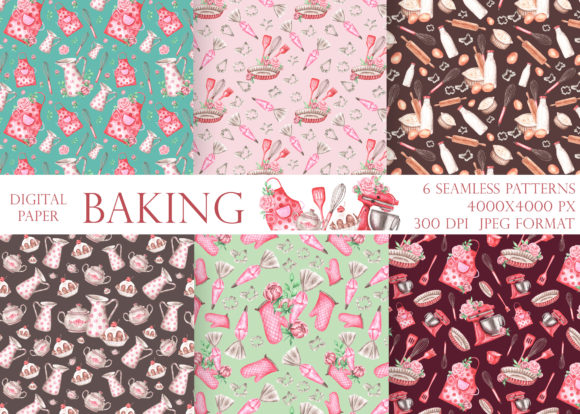
The package delivers six JPEG files, each 4000×4000 pixels at 300 DPI—equivalent to 41×41 inches when printed at full resolution. That scale supports large-format applications without pixelation: think custom bakery packaging, fabric banners for farmers’ markets, or notebook covers sold through independent stationery shops. All files are delivered in a single ZIP folder with no licensing restrictions beyond standard personal and commercial use (always verify the seller’s license terms before resale or SaaS integration).
Each pattern is built from layered, individually illustrated components—including aprons, rolling pins, flour sacks, sugar bowls, whisks, eggs, milk jugs, and botanical accents like leaves and blossoms. These aren’t stock silhouettes; they’re 100% hand-painted watercolor elements scanned and digitally arranged into repeatable layouts. The result is subtle texture variation, soft edges, and natural pigment bleed—qualities that resist the flatness common in vector-based or AI-generated patterns.
Usability in Real Workflows
Because the files are JPEGs—not layered PSDs or editable vectors—their primary strength lies in immediate application rather than deep customization. Designers using Adobe Photoshop can adjust color balance, contrast, or opacity to match brand palettes, or overlay text and photography directly onto the pattern. For users of Affinity Photo or free tools like GIMP, JPEG compatibility remains straightforward. However, those needing scalable resizing, path editing, or individual element isolation will find limitations—this isn’t a vector toolkit, nor is it meant to be.
Seamless tiling is consistent across all six patterns. Tested across multiple design platforms—including Canva, Illustrator (via raster import), and print-on-demand services like Printful—the repeats hold up cleanly at both small (e.g., 2×3 inch sticker sheets) and large (e.g., 24×36 inch wall art) dimensions. No visible seams or alignment hiccups were observed during testing on matte paper, cotton fabric, and ceramic decal transfers.
Where This Resource Fits Best
Baking Watercolor Digital Paper. Bakery excels in contexts where visual tone supports narrative intent. A small-batch cookie brand launching seasonal packaging benefits from its handmade aesthetic—readers intuitively associate watercolor textures with care, tradition, and small-scale production. Similarly, cookbook authors building interior page backgrounds or chapter dividers gain cohesion without sacrificing elegance. Educators designing printable baking worksheets for culinary students find the illustrations clear enough for labeling exercises yet expressive enough to engage learners visually.
Freelance designers working with bakeries on rebranding projects may use these patterns as base layers beneath logos or typography—particularly when clients want to signal authenticity over industrial precision. Likewise, indie stationery makers applying the designs to greeting cards, gift tags, or washi tape gain ready-to-use motifs that avoid copyright risk associated with unlicensed food imagery.
Practical Considerations and Limitations
While the hand-painted quality is a strength, it also defines boundaries. The palette leans toward warm neutrals—creams, ochres, muted sage greens, and soft terracottas—with limited saturated tones. If your project requires bold magentas, electric blues, or high-contrast monochrome, color adjustment in Photoshop is necessary but may reduce the watercolor effect’s subtlety. Also, because compositions include recurring objects (e.g., two types of baking tins, multiple whisk angles), absolute uniqueness per pattern isn’t guaranteed—but variation between the six options remains sufficient for most branding systems needing complementary background textures.
There’s no SVG, PNG with transparency, or Procreate brush set included—so digital illustrators seeking layered assets for animation or interactive media will need to source additional resources. And while the files are print-ready, users preparing for offset printing should still run preflight checks for embedded profiles (sRGB is standard here) and confirm bleed requirements with their printer.
Who Benefits Most—and How to Use It Well
This resource serves creators who value speed *and* aesthetic integrity. Small business owners launching an Etsy shop for custom baking aprons can apply one pattern directly to fabric mockups in minutes. Bloggers producing Pinterest-optimized recipe roundups can use another as a textured background behind food photography—adding depth without competing with the subject. Publishers developing a series of themed cookbooks might assign a different pattern to each volume (e.g., “Spring Pastries” uses the floral-accented layout; “Holiday Breads” opts for the flour-and-rolling-pin variant), reinforcing visual continuity across titles.
A practical recommendation: Start by importing one JPEG into your layout software and scaling it to fill your canvas at 100%. Then test how it interacts with type size and weight—watercolor textures can recede visually, so bolder fonts often pair better than delicate serifs. For packaging, consider using a lighter pattern variant on primary boxes and a denser one on inner tissue wraps to create hierarchy. When applying to textiles, request a physical swatch first—some inkjet printers mute watercolor grain more than screen printing does.
Long-Term Value and Integration
Digital paper collections like Baking Watercolor Digital Paper. Bakery offer lasting utility precisely because they’re format-agnostic and platform-resilient. JPEGs work today in Figma, tomorrow in emerging design tools, and decades from now in archival PDFs—unlike proprietary file types that risk obsolescence. Their value compounds when used across touchpoints: the same pattern appearing on a bakery’s Instagram story background, its product labels, and its staff training manual creates subconscious brand reinforcement.
That said, longevity depends on thoughtful usage—not just repetition. Reusing the exact same tile across every customer-facing asset can dilute impact over time. Instead, treat each of the six patterns as distinct moods: one for warmth and nostalgia, another for freshness and botanical lightness, a third for rustic utility. Rotate them intentionally, and pair with original photography or illustration to avoid visual fatigue.
In summary, Baking Watercolor Digital Paper. Bakery fills a specific, well-defined niche: high-resolution, hand-crafted texture for food-adjacent creative work. It won’t replace custom illustration or solve complex branding strategy—but for professionals balancing deadlines, budget, and aesthetic standards, it delivers reliable, tasteful, and production-ready support.